Multifamily Financing Sources in 2026: A Guide to Commercial Mortgage Options
Think you know your way around the lending spectrum when it comes to multifamily loans?
The commercial mortgage market has never stood still, but today it seems to evolve faster than ever. Loan programs change. Credit guidelines tighten. New lenders enter the market while others adjust their appetite for risk.
For commercial mortgage brokers and multifamily investors, keeping up with those changes can be challenging.
Take Freddie Mac’s Small Balance Loan program, for example. In 2026, Freddie integrated the program into its broader Conventional platform, increasing the minimum loan amount from $1 million to $2 million and simplifying its pricing structure. While the changes make the program more efficient, they also mean some transactions that previously fit neatly into Freddie’s guidelines now require a different financing solution.
That $1.4 million multifamily loan you expected to place with Freddie? It may no longer qualify.
At Silver Hill Capital, we like to say we specialize in finding solutions for borrowers and brokers—even if the right solution isn’t one of our own loan programs.
With that philosophy in mind, here’s a look at today’s primary commercial mortgage financing options for multifamily properties, when each works best, and where each may fall short.
Four Primary Sources for Multifamily Loans
Commercial multifamily financing typically falls into one of four categories:
- Traditional Bank Lenders
- Agency (Fannie Mae and Freddie Mac) Loan Programs
- Private and Hard Money Lenders
- CMBS (Commercial Mortgage-Backed Securities) Lenders
The best fit will depend on a number of factors, not just the interest rate and time to close. Let’s take a closer look.
Traditional Bank Loans
Banks continue to be particularly competitive on smaller multifamily transactions, often financing properties ranging from five-unit apartment buildings to mid-sized communities.
They are typically able to offer low rates and favorable terms in order to keep depository relationships in house. For many prospective borrowers, their bank should be the first stop in the quest to secure a commercial mortgage.
The issue is that banks are known for being more conservative when it comes to commercial loan approvals. In many cases, banks seek to limit the number of commercial mortgages they keep on their books, so they can afford to “tighten the box” when it comes to credit requirements or underwriting protocols and keep loan terms relatively short.
Another way this conservative viewpoint reveals itself is through the refinance process. Depending on a bank’s outlook or current corporate strategy, they may inform a borrower that they’ll need to seek refinancing elsewhere. This creates a situation where the borrower must scramble to find an alternative solution for their commercial mortgage.
Still, the local or regional bank is a smart choice for investors and a good starting point for commercial mortgage solution providers seeking the “best” deal.
Agency Loans: Fannie Mae and Freddie Mac
Both Fannie Mae and Freddie Mac offer long-term financing designed specifically for multifamily housing. Their programs typically provide attractive interest rates, higher leverage, and non-recourse structures that many investors prefer.
Agency loans, offered through approved, third-party lenders, offer several advantages that are difficult for other lenders to match, like high LTVs and low rates.
But they also feature strict requirements that limit the chances of approval for many of today’s investors. Properties generally need to be stabilized with consistent cash flow, while borrowers must be prepared to provide extensive documentation for income verification purposes.
Private and Hard Money Loans
When speed and certainty of closing are the highest priorities, Private and Hard Money lenders often make the most sense for multifamily investors.
These lenders fill an important gap within the commercial mortgage market by financing deals that fall out of bank guidelines for one reason or another. These loans are often used for acquisitions, renovations, lease-up projects, or distressed properties.
Oftentimes, Hard Money loans are designed to be a temporary solution before long-term financing is possible. This type of financing can give investors time to improve their property, increase occupancy, or make positive changes to their own creditworthiness.
One of the main benefits here is speed. Private lenders can close in a matter of days instead of weeks or months. But that speed comes at a cost – interest rates for this type of financing are higher than alternative sources.
For certain investors, this tradeoff is worthwhile. Private financing serves as a bridge to help them eventually achieve their long-term goals.
CMBS Loans
Commercial Mortgage-Backed Securities (“CMBS”) loans remain an important financing source for larger stabilized multifamily properties. Rather than holding loans on their balance sheets, lenders pool these commercial mortgages into securities that are sold to investors.
Lenders in this area prefer experienced investors, stabilized properties, and long-term financing requests. Post-closing flexibility is limited and early payoffs are expensive, which makes sense considering the final destination of the loan.
CMBS loans make sense for investors with multiple properties and a consistent need for financing. If their loan requests fit the lender’s “box,” they can expect to scale their portfolio more easily than they could with a bank that deals with portfolio concentration concerns or general lending limits.
A Framework for Commercial Multifamily Financing:
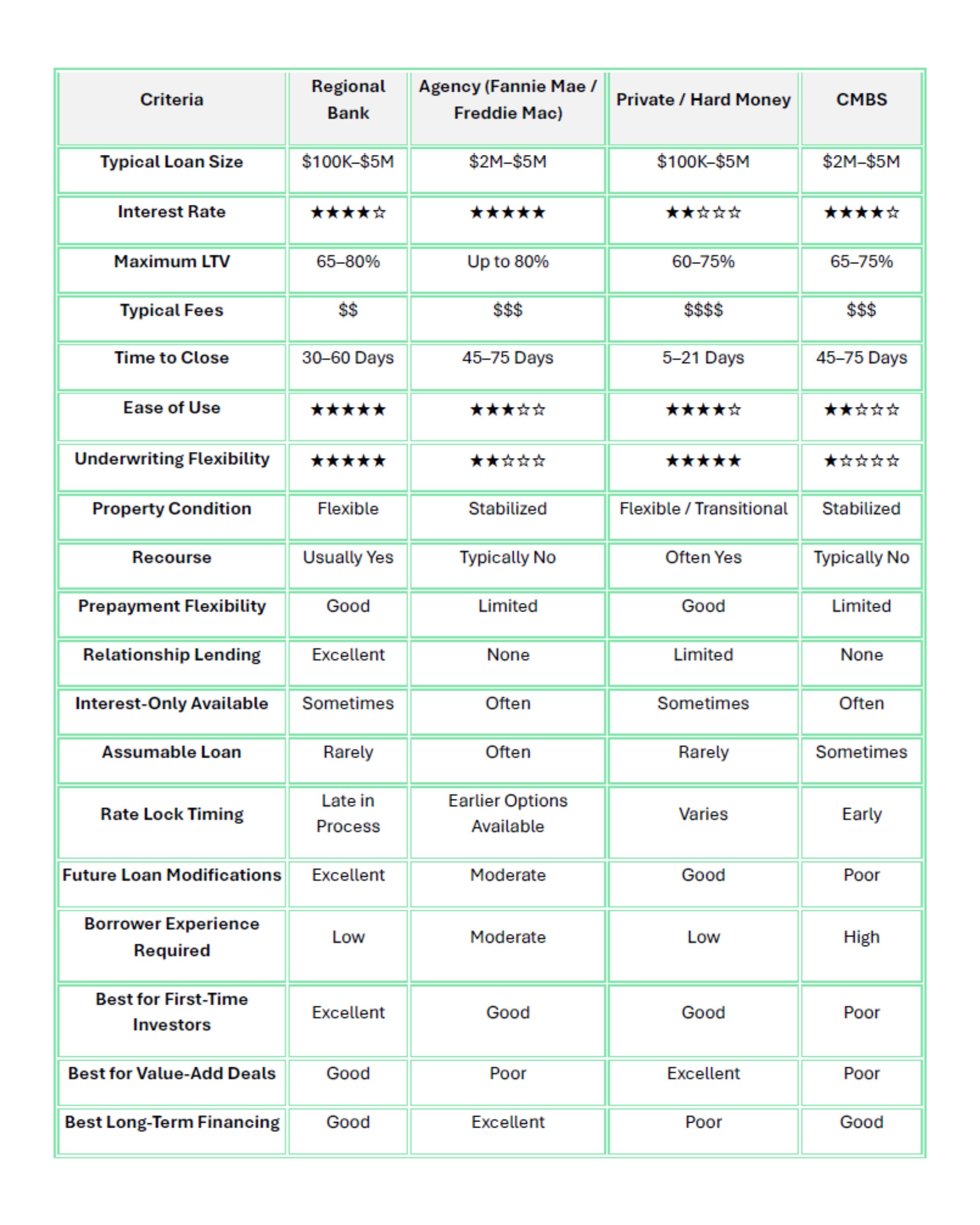
Every financing source has strengths and weaknesses. The best fit for any financing request is going to depend on the borrower’s creditworthiness, experience, financial goals, timeline, and property condition.
Here is a basic framework to help brokers find the best fit for their clients:
Regional Banks are often the first choice for creditworthy investors who value the flexibility and benefits that come with strong relationship-based lending.
Agency Loans are typically the preferred permanent financing solution for stabilized multifamily properties and investors who are able to provide extensive documentation.
Private Lenders bridge the gap for value-add and time-sensitive opportunities.
CMBS Loans serve investors with high-quality stabilized assets who are comfortable trading post-closing flexibility for attractive long-term pricing and scalability.
This chart can help you compare options more easily: